How Often Should Photographers Actually Post in 2026.
Annie Leibovitz posts roughly once a month and has a million followers. What the 2026 data actually says about cadence for working photographers.
Jun 25, 2026
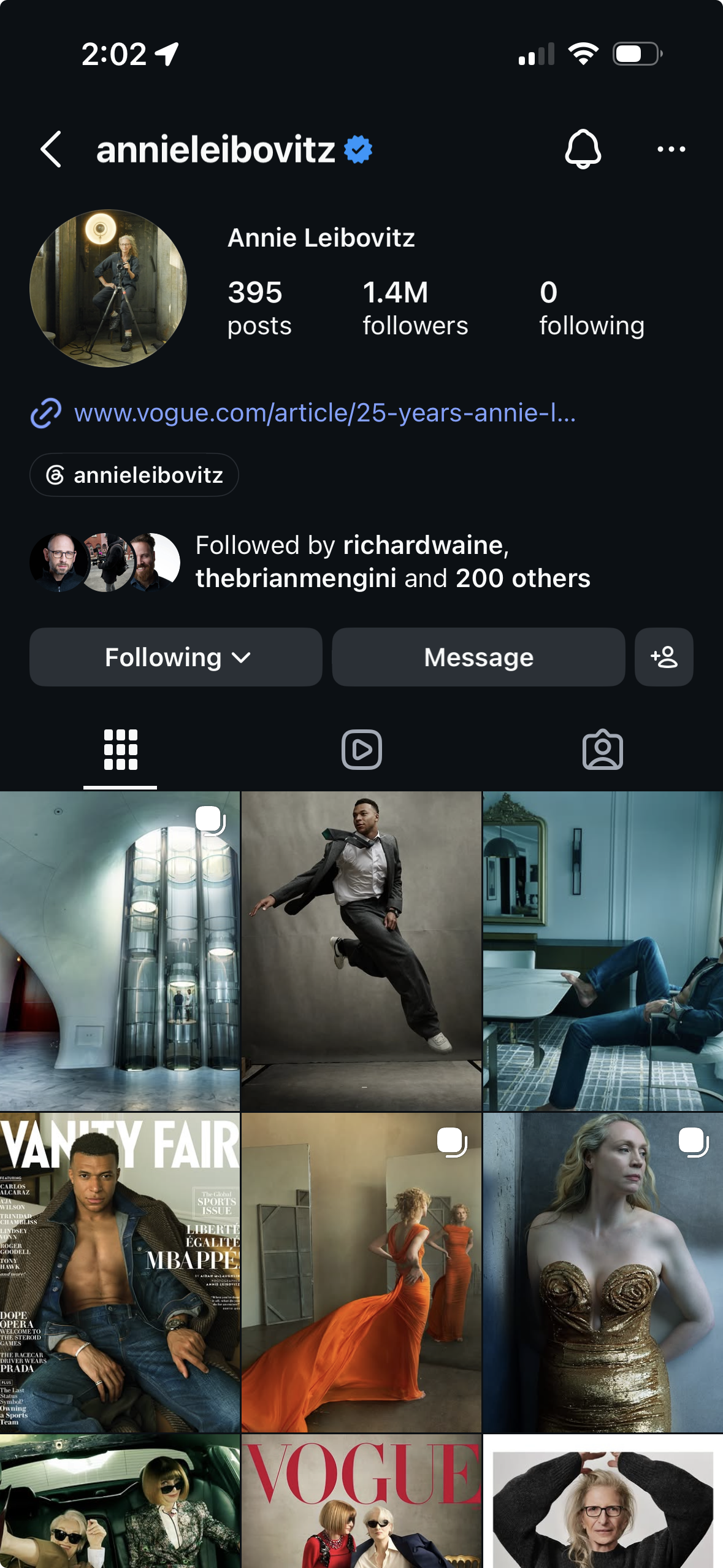
Annie Leibovitz has 1.4 million followers on Instagram. She has posted, in total, 395 times. The account is run by her studio (probably) and the cadence works out to roughly once a month. The most prestigious portrait photographer alive doesn't post daily or even weekly. And she doesn't seem worried about it. Meanwhile a parade of LinkedIn coaches is telling working photographers they need to ship daily content across five platforms or watch their business die. When I read her post count at first I was super shocked but ya know what? It makes sense.
The 2026 data, FYI, doesn't back the coaches up. It backs Annie up.
Consistency is not frequency
This is the move the whole conversation hinges on, and most people miss it.
Jay Clouse from Creator Science has the clearest version I've seen. "Consistency develops trust. Frequency compresses the time it takes to develop skills. They are independent variables." Daily isn't consistency. It's just volume that might be consistent.
Two posts a month, every month, on the same kind of rhythm, with the same quality bar, is more consistent than daily-for-three-weeks-then-gone-for-two-months. I spent YEARS doing the second version. I would post a photo every morning for three or four days, get tired, disappear for a month, feel guilty, come back at it, disappear again. That's not consistent. That's a binge.
Even Jasmin Alić, who built a 340,000-follower LinkedIn following coaching people on personal branding, has publicly said he has never posted seven days in a row. His actual line is "Post consistently, not daily. Post quality only, never quantity." The guy people quote when they want you to feel bad about posting twice a week is on the same side of this as we are. The "post every day" gospel has detached from the people who supposedly preach it.
What the 2026 data actually says
Buffer pulled 52 million posts across 200,000 accounts for their March 2026 State of Social Media Engagement report. The top performers on almost every platform cluster around the same number. Three to five posts a week.
- LinkedIn: 4-5/week
- Instagram: 3-4/week
- TikTok: 4-5/week
- Threads: 3-4/week
- Facebook: 3-4/week
After about five posts a week, the growth curve flattens hard. Buffer data scientist Julian Winternheimer put it this way, "The most important factor probably remains content quality. You're probably not going to see big gains in followers and reach by pumping out low-quality posts." When I read that I felt a little vindicated, honestly.
To be fair, posting more does help follower growth in aggregate. Going from 1-2 a week to 3-5 adds about 0.14 percentage points of weekly growth. Going from 6-9 to 10+ adds another 0.22. For a 5,000-follower account that's maybe 11 extra followers a week to roughly triple your workload. The math isn't great. And the same data shows reach per post drops as frequency climbs.
The other thing nobody talks about. The Creator Economy Research Institute reported in Q1 2026 that 62% of full-time creators show burnout symptoms and 47% considered quitting in the last six months. That's the actual cost of the "ship daily" advice. It's not free. If you can't sustain something long term.. it probably isn't worth it.
Why this hits photographers harder
A LinkedIn ghostwriter can ship five posts a week because text is cheap. For a photographer the sourcing is more work, but it's actually completely possible if you're shooting enough. My two posts a week are usually client photos. The thinking is simple, if I saturate people's feeds with my work, they're reminded of me, and they might book a session when the time comes. So "not enough images" is rarely the real problem. The real problem is being told you need to ship a Reel, a LinkedIn carousel, a Pinterest pin, and a TikTok every day on top of that.
The Leibovitzes and Sean Tuckers and Felix Kunzes of the field post less than the coaches tell working photographers to. The exceptions ie. the Brandon Woelfels of the world built businesses natively on Instagram which is a different business than running a portrait studio. Your cadence has to match the model.
I wrote a piece a few weeks back called You Don't Need New Content. You Need a System. about how your existing archive is enough to fill your schedule. That piece covers the what to post. This one is about where, and how often.
Instagram (3-5/week)
The image is the entire pitch here. Caption is secondary. Mosseri confirmed the top three ranking signals for 2026 are watch time, DM shares (sends per reach), and likes per reach. Original content gets a boost over reshares. Carousels are currently the highest-engagement format (around 1.92% ER vs Reels at 1.74%). Reels still win reach, no shocker there.
One thing that catches people off guard. The profile grid moved to a 4:5 vertical (3:4 on the grid) crop in early 2025. Square grids that worked for a decade are now actively broken on most profiles. If your portfolio grid still looks like a checkerboard of squares, it might be cropping in ways you didn't approve. I don't think that's a huge dealbreaker as most people are looking in the actual feed not your profile directly. If your profile looks good it's a nice touch though.
Quality bar: a strong 4:5 cropped image. Carousels for "5 frames from one session" outperform single images on engagement. Reels with a visual hook in the first 0-3 seconds (the lighting setup reveal, the client's reaction, the actual moment of the shot) outperform static portfolio Reels.
Sweet spot: 4/week (if possible), ie. one carousel, one Reel, one single image, one Story-only day. Above 7/week without segmentation, unfollow rates climb (around 25% higher, per Kamero's 2026 photographer data).
LinkedIn (3-4/week)
This is the platform photographers get most wrong, and the one with the strictest mechanical ceiling. LinkedIn distributes a post over an 18-24 hour window. If you post a second time inside that window, it actively suppresses the first one. So daily posting isn't just diminishing returns on LinkedIn, it's negative returns. Posting twice a day cannibalizes your own reach. File your complaints to Microsoft..
Comments are weighted around 15x more than likes. Dwell time is the dominant signal (posts with 60+ second dwell get about 15.6% engagement, posts with 0-3 second dwell get about 1.2%, a 13x gap). LinkedIn also rejects more than half of posts before any audience even sees them in 2025, up from 40% the year before. The spam filter is real. If you have ever been put in LinkedIn jail, you know what I mean.
Quality bar: this is the only platform where the image plays second to the words. The post is a story. A client moment. Maybe a small lesson from a shoot, or just a craft observation that's been rattling around your head. The image supports the story. Photographers who treat LinkedIn like Instagram (image-first, hashtag-stuffed) get throttled. A 6-line story about a client who hadn't been in front of a camera in 10 years, ending with the headshot, will out-perform that headshot posted on its own. Every time. If you feel like you just don't have time to write dedicated posts for a platform like LinkedIn, repost what you are already posting to Instagram. Some presence on a platform is better than none.
Sweet spot: 3-4/week, Tuesday-Thursday mornings ET. One real post a day max.
TikTok (3-5/week if you're committed to video)
In 2026 there was an algorithm change. TikTok now tests new videos with your existing followers first, before pushing to non-followers. Your warm audience seeds distribution. There's also a niche-consistency penalty now, posting across 3+ unrelated topics drops reach by around 45%. So if you're going to be on TikTok as a photographer, be a photographer on TikTok. Don't drift too much.
Quality bar: a visual hook in the first 0-3 seconds. Not "Hi guys, today I want to talk about lighting." Show the impossible-looking shot first, explain after. "what 3 lights I used," BTS process. Shot vertical, native, no Reels watermarks if you can help it. TikTok does accept photo posts.. I have found that photo posts with trending TikTok music increase the reach of the posts vs. photo posts without music. Something to think about adding if you just want to get some content on the platform
Sweet spot: 5/week if TikTok is a real channel for you.
YouTube long-form (1-2/month)
This is where the data and the reality of being a working photographer actually agree. Channels uploading 12+ videos a month grow 66% faster than channels uploading 1-3, but those channels are full-time creators, not photographers running a business. One solid behind the scenes video a month, or even just one every two months, is enough. YouTube launched a Creator Wellness Program in January 2026 that reduces the algorithmic penalty for temporary inactivity, ie. the platform itself is acknowledging the cycle which is better than most.
Quality bar: teaching value. Tutorials, gear reviews (if you want to go that route), BTS, business advice, location walkthroughs etc. Just throwing ideas out there, you can really do anything photo related. Thumbnail and the first 30 seconds carry disproportionate weight. Search-intent titles ("How to light a corporate headshot") perform better than vibe titles ("Day in the life").
Sweet spot: 1-2 a month for a working photographer. No shame in that.
YouTube Shorts (3-5/week, recycled)
If you're already doing long-form, Shorts are essentially free content. Clip a 60-second moment out of your tutorial, vertical aspect, hook in the first 1-2 seconds. Around 74% of Shorts views come from non-subscribers, so this is your discovery layer. RPM is brutal ($0.03-$0.08 vs around $5 on long-form) but the discovery payoff is real. Channels combining Shorts and long-form grow about 41% faster.
Sweet spot: 3-5/week, mostly recycled from your long-form pipeline.
Pinterest (3-5 fresh pins/week)
Pinterest is search-first, not feed-first. You're not building a follower base, you're optimizing for what people type into the search bar. Pins have a 6-12 month lifespan, way longer than anything on IG. "Fresh" now strictly means new image file + new URL + non-duplicate description, repinning your old stuff is dead as a signal.
Quality bar: vertical 2:3 frames (1000×1500 is the spec). Title with search intent ("modern corporate headshot Philadelphia," not "Sarah's shoot"). Description with keywords. Link to a blog post or service page on your website.
Sweet spot: 3-5 fresh pins/week per topic cluster. This is the long game, ie. don't expect results for 6 months.
Threads, X, Bluesky (low effort, still worth a presence)
There's not a huge photographer presence on these platforms, but having a presence everywhere is always helpful. Threads and X reward replies and hot takes more than images, and Bluesky is still tiny. You don't need to be active in any serious way, but a profile that's clearly yours with a few posts beats nothing. The easiest move is to mirror what you're already posting on Instagram so you're not building separate content for them.
Substack (only if you want to write)
If you have long-form thinking that doesn't fit in an Instagram caption, Substack is a good place to put it. One newsletter a week plus a Note or two is the 2026 baseline. For most photographers though, your blog on your own website does the same thing, and you own the audience. Longform content also works well on LinkedIn either as posts or articles.
The 1+1+1 week
If you take nothing else from this, take this protocol. PLEASE try it before adding anything else.
- One hero Instagram post (a carousel or a single image, your call)
- One story-around-an-image LinkedIn post
- One vertical Reel or Short, repurposed across IG, YouTube Shorts, and TikTok if you're on it
That's three deliberate pieces a week. It puts you in the sweet spot on Instagram and LinkedIn (the two platforms that actually matter for most working photographers). You also get a discovery layer on Shorts/Reels. Pinterest can sit as a separate batched task if it fits.
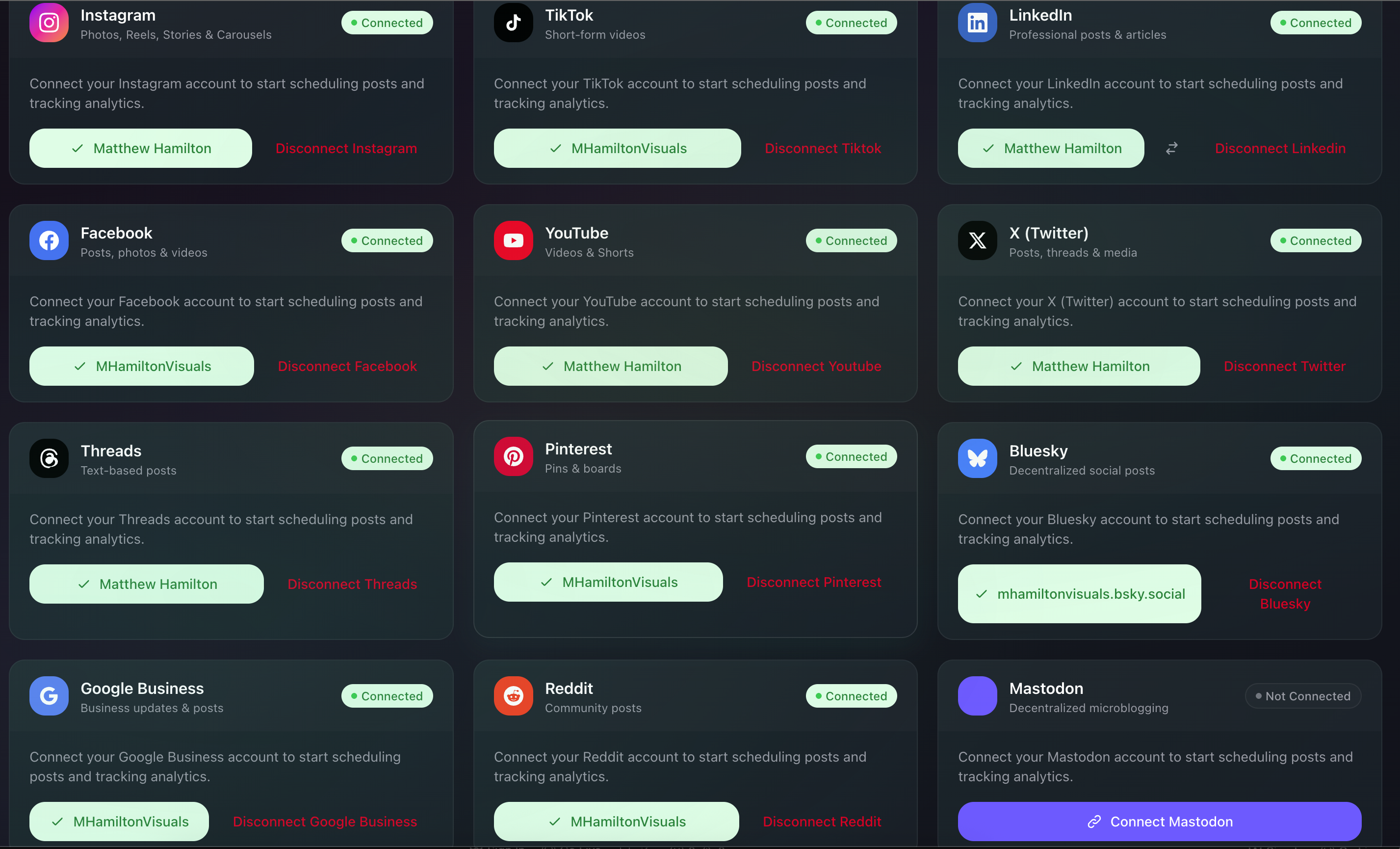
One day a week to plan them, one tool to schedule them. I use StudioFlows because it's built for this exact workflow, one place for all platforms, and you can set posts to auto-repost on whatever interval you want so old work resurfaces without you thinking about it. Three posts a week scheduled to repost annually is effectively 150+ posts in your archive working on rotation.
Daily isn't consistency. It's just volume that might be consistent.
Matthew Hamilton
The hardest part of all of this isn't the system. It's giving yourself permission to post less.
"Post every day" is seductive because it confuses visible effort with actual results. Showing up daily feels like you're doing the work. The numbers say you're mostly making yourself tired. Annie Leibovitz posts monthly. Sean Tucker posts intermittently. The actual top of the field is not grinding daily content. They're shooting and delivering. The work does the rest.
You don't need to be on every platform. You don't need to post every day. You might already have enough work in your archive to post 3-5 times a week for the next year without taking a single new image. The system is the 10-minute reuse protocol, plus the 1+1+1 week, plus a scheduler that handles the repeating.
Pick three platforms. Pick a cadence you can hold for a year. Skip the rest. See how you feel in six months. More from The Scoop.
The 2026 data converges on 3-5 posts a week as the sweet spot across every major platform. Going higher offers diminishing returns and on LinkedIn actively suppresses your own reach inside an 18-24 hour distribution window. Annie Leibovitz posts roughly monthly and has a million followers. Consistency is not the same as frequency. Run the 1+1+1 week (one Instagram hero, one LinkedIn story-around-an-image, one Reel/Short), schedule it in [StudioFlows](https://studioflows.app), stop thinking about content until the next shoot.
Written by
Matthew Hamilton
Portrait photographer and automation specialist based in Philadelphia. Focused on building streamlined workflows and elevated client experiences that make the business side of photography as polished as the images.